

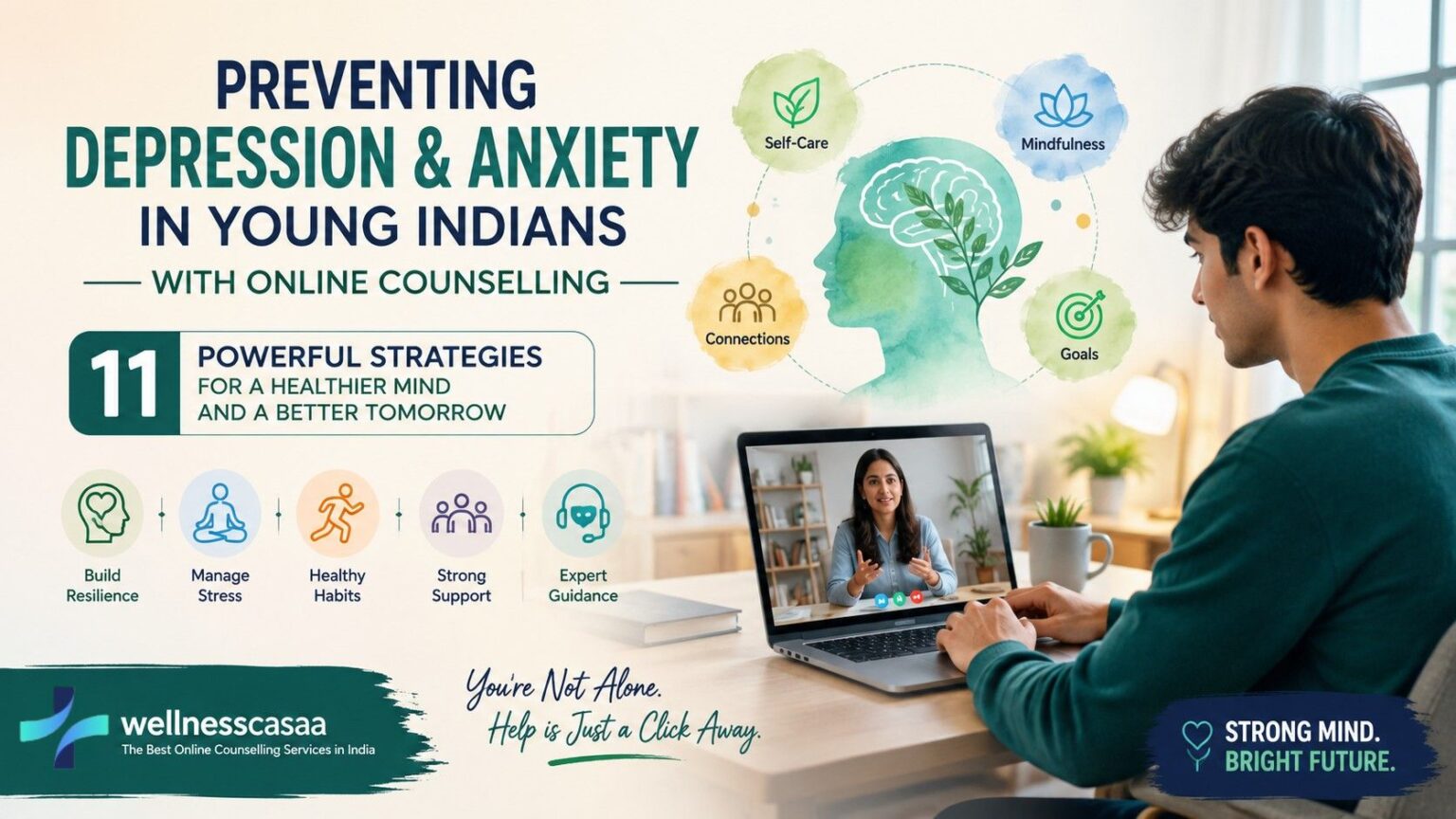
Online Counselling for Young Indians
Young adulthood can be exciting, but it can also feel like a pressure cooker. Students and young professionals in India may be dealing with examinations, entrance tests, career uncertainty, financial concerns, family expectations, relationships, social comparison and the pressure to appear successful.
That doesn’t mean every difficult period is depression or an anxiety disorder. Feeling worried before an examination or disappointed after a setback is a normal part of life. The concern arises when distress becomes persistent, intense or disruptive and starts affecting sleep, studies, work, relationships or everyday functioning.
The World Health Organization (WHO) reports that approximately one in seven people aged 10–19 globally experiences a mental health condition, while anxiety and depression are among the leading causes of illness and disability in this age group. WHO also emphasizes protective factors such as healthy sleep, exercise, emotional skills, problem-solving abilities and supportive relationships.
This makes prevention particularly important.
Preventing Depression and Anxiety in Young Indians with Online Counselling isn’t about trying to eliminate every negative emotion. Instead, it means developing healthier ways to understand emotions, manage stress, seek support and respond to problems before they become overwhelming.
Online counselling can be one part of that process. It doesn’t replace emergency care or specialist psychiatric treatment when those are required, but professional counselling can offer young people a convenient way to discuss concerns, learn coping strategies and understand recurring emotional patterns.
1. Understanding Depression and Anxiety in Young People
What Is Depression?
Depression is more than occasionally feeling sad. WHO describes depression as involving persistent low mood or loss of interest or pleasure, often accompanied by other symptoms and meaningful impairment in daily life.
A young person experiencing depression may:
- Lose interest in hobbies or activities they previously enjoyed.
- Feel persistently sad, empty, irritable or hopeless.
- Experience changes in sleep or appetite.
- Have difficulty concentrating.
- Feel unusually tired or unmotivated.
- Withdraw from friends and family.
- Struggle academically or professionally.
- Develop feelings of worthlessness or excessive guilt.
These signs don’t automatically establish a diagnosis. A qualified mental-health professional needs to assess the person’s symptoms, history and circumstances.
What Is Anxiety?
Anxiety becomes a concern when fear or worry is excessive, difficult to control, persistent and disruptive. Symptoms can include restlessness, tension, difficulty concentrating, sleep problems, sweating, trembling, nausea or a racing heartbeat.
Anxiety can show up differently in different people. One student may constantly worry about grades, while another may avoid social situations or experience intense physical symptoms before presentations.
Depression and Anxiety Can Overlap
Depression and anxiety aren’t always separate experiences. Someone may feel anxious about the future while simultaneously losing motivation and hope.
That’s why early attention matters. Young people shouldn’t have to wait until they reach a breaking point before talking to someone.
2. Why Young Indians May Experience Increased Emotional Pressure
India’s young population lives within a wide variety of family, educational, cultural and economic environments. There isn’t one single “Indian youth experience.”
However, several pressures commonly affect young people.
Academic Competition
Entrance examinations, board examinations, university admissions and competitive career paths can create prolonged stress.
A young person may start believing that one examination determines their entire future. That thinking can increase anxiety and make ordinary setbacks feel catastrophic.
Career Uncertainty
The transition from education to employment can be challenging. Young adults may compare their progress with friends who appear to have better jobs, salaries or lifestyles.
Social media can make this comparison even stronger.
Family Expectations
Many young Indians maintain close relationships with parents and extended family. These relationships can provide excellent emotional support, but expectations around education, career, marriage and financial success may sometimes become stressful.
The goal isn’t to blame families. Rather, healthy communication can help families distinguish encouragement from pressure.
Relationship and Social Challenges
Friendships, romantic relationships, loneliness, bullying and social rejection can have a substantial emotional impact.
WHO identifies supportive relationships and environments as important protective factors for adolescent mental health.
3. Early Awareness Is One of the Strongest Prevention Tools
Learn to Recognize Changes
Prevention begins with noticing patterns.
Instead of asking, “Am I happy every day?” ask:
- Has my mood changed significantly?
- Am I withdrawing from people?
- Am I sleeping much more or less?
- Am I constantly worrying?
- Have I stopped enjoying things?
- Am I struggling to concentrate?
- Is stress interfering with my studies or work?
- Have people close to me noticed a change?
A short period of stress may resolve with rest and support. Persistent or worsening symptoms deserve greater attention.
Build Mental Health Literacy
Mental health literacy means understanding basic concepts about emotional well-being, symptoms, treatment and help-seeking.
It also helps reduce stigma.
For example, seeing counselling as a form of healthcare rather than a sign of weakness can make it easier for a young person to seek assistance early.
WHO notes that stigma and barriers to accessing care can contribute to untreated mental-health conditions.
4. Build Emotional Resilience Before a Crisis
Resilience doesn’t mean never struggling. It means developing skills that help you recover and adapt when life becomes difficult.
Practice Emotional Awareness
Try naming what you’re experiencing.
Instead of saying, “I feel bad,” consider whether you’re feeling:
- disappointed,
- anxious,
- lonely,
- angry,
- overwhelmed,
- embarrassed,
- exhausted,
- uncertain.
Naming an emotion can make a vague problem more manageable.
Develop Problem-Solving Skills
When something goes wrong, divide the issue into controllable and uncontrollable elements.
For example:
Problem: Fear about an upcoming examination.
Controllable:
- Study schedule.
- Sleep.
- Practice tests.
- Asking for academic help.
Less controllable:
- The exact examination questions.
- Other students’ performance.
- The final result.
This approach shifts attention from endless worrying toward practical action.
Use Healthy Coping Methods
Useful coping strategies include:
- Talking with someone trustworthy.
- Going for a walk.
- Writing down worries.
- Practising slow breathing.
- Taking structured breaks.
- Returning to enjoyable activities.
- Maintaining a regular sleep schedule.
- Seeking professional counselling when needed.
WHO similarly recommends physical activity, regular sleep and eating habits, relaxation techniques and mindfulness as useful components of mental-health self-care.
5. Protect Sleep, Exercise and Daily Routines
It sounds basic, but the basics matter.
Sleep Is Mental-Health Maintenance
Irregular sleep can make concentration, emotional regulation and stress management harder.
Young adults should aim for a reasonably consistent sleep and wake schedule rather than repeatedly sacrificing sleep for studying, work or entertainment.
Late-night scrolling can be particularly disruptive.
Move Your Body
Exercise doesn’t have to mean joining an expensive gym.
Walking, cycling, yoga, sports, dancing or home workouts can all provide physical activity.
The objective is consistency, not perfection.
Eat Regularly
Skipping meals because of examinations, deadlines or work can make an already stressful period harder to manage.
A balanced eating pattern supports general physical health, which is closely connected with mental well-being.
Create a Simple Routine
A realistic routine might include:
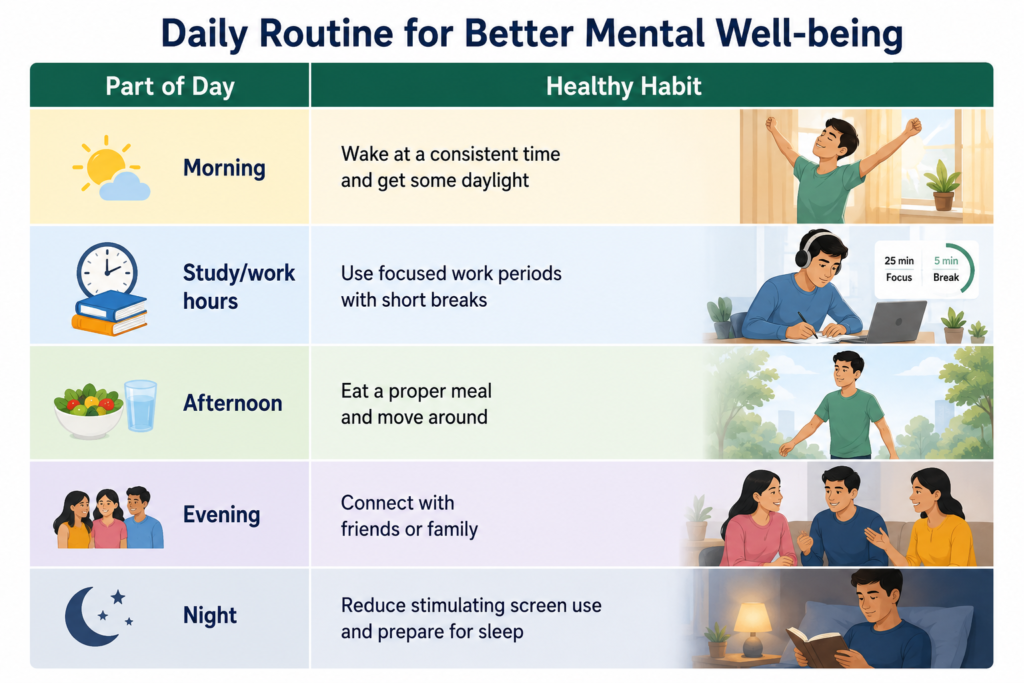
Small habits may not solve severe depression or anxiety on their own, but they can strengthen the foundation on which professional support works.
6. Manage Academic and Career Stress More Realistically
Replace “Everything or Nothing” Thinking
Young people sometimes think:
“If I fail this exam, my life is over.”
That thought feels powerful, but it isn’t necessarily accurate.
A healthier approach is:
“This result matters to me, but it doesn’t define my entire future.”
There can be multiple routes to a meaningful career.
Set Process Goals
Instead of focusing only on outcomes, establish measurable daily actions.
For example:
- Complete two chapters.
- Solve 30 practice questions.
- Spend one hour revising.
- Apply for two suitable jobs.
- Contact one professional for career guidance.
Process goals create a sense of control.
Take Strategic Breaks
Working continuously doesn’t necessarily produce better results. Planned breaks can help prevent mental fatigue.
The old-school idea that “more hours always means more success” isn’t particularly useful when those hours are spent staring at a page without absorbing anything.
7. Create Healthier Digital and Social Media Habits
Digital technology can connect young people with friends, educational resources and mental-health services. At the same time, excessive or unhealthy digital use can contribute to comparison, distraction and disrupted routines.
Watch for Social Comparison
Online profiles usually show selected moments rather than someone’s entire life.
Comparing your everyday struggles with another person’s highlight reel is an uneven comparison.
Set Boundaries
Consider:
- Turning off unnecessary notifications.
- Keeping the phone away during focused study.
- Avoiding doom-scrolling before sleep.
- Unfollowing accounts that consistently make you feel inadequate.
- Creating device-free meals or conversations.
Use Digital Tools Constructively
Technology can also support mental well-being through:
- Online counselling.
- Educational mental-health resources.
- Guided relaxation.
- Appointment scheduling.
- Supportive communities.
The key is intentional use.
8. Strengthen Family, Friendship and Community Support
Young people don’t have to handle everything alone.
Talk Before the Problem Becomes Huge
A simple conversation can be enough to start:
“I’ve been feeling overwhelmed lately, and I could use someone to talk to.”
You don’t need to present a perfectly organized explanation.
Listen Without Immediately Judging
Parents, friends and partners can help by listening rather than immediately saying:
- “Just relax.”
- “Everyone goes through this.”
- “You have nothing to worry about.”
- “Other people have bigger problems.”
Those comments may be intended to help, but they can make someone feel dismissed.
A better response is:
“That sounds difficult. Do you want to talk about what’s been happening?”
Build Multiple Sources of Support
One person shouldn’t have to become an entire support system.
A healthy network might include:
- Family.
- Close friends.
- Teachers or mentors.
- Counsellors.
- Doctors or psychiatrists when appropriate.
- Community or peer-support resources.
9. How Online Counselling Can Help Young Indians
Online counselling can make professional psychological support easier to access, particularly for young people who face barriers such as distance, busy schedules, discomfort with visiting a clinic or concerns about privacy.
Convenience and Accessibility
A young adult living away from home may find it easier to schedule a counselling session online than travel across a city.
For students, remote workers and young professionals, flexible appointments can fit more naturally around daily commitments.
A More Comfortable Starting Point
Some people feel nervous entering a counselling clinic for the first time.
Starting a session from a private, appropriate setting can feel less intimidating.
Continuity of Care
When appropriate and clinically suitable, online sessions can make it easier to maintain regular appointments.
Consistency matters because counselling is usually a process rather than a one-time conversation.
What Online Counselling Cannot Replace
Online counselling isn’t appropriate for every situation.
Someone experiencing an immediate safety crisis, severe psychiatric symptoms or a medical emergency may need urgent in-person assessment and emergency support.
India’s National Tele Mental Health Programme, Tele-MANAS, was established to provide 24/7 tele-mental-health services across India and includes counselling, specialist linkage and connections to in-person services.
For official information, see the Government of India’s National Mental Health Programme information.
10. Choosing a Reliable Online Counselling Service
Not every online mental-health platform offers the same level of care.
Young Indians and their families should evaluate a service carefully.
Check Professional Qualifications
Look for appropriately qualified mental-health professionals and clear information about their credentials and areas of practice.
Understand Confidentiality
Before beginning, understand:
- How personal information is handled.
- Whether sessions are confidential.
- What circumstances may require confidentiality to be broken.
- How records are stored.
- Whether the platform uses secure communication technology.
Consider Therapist Fit
A therapist can be appropriately qualified and still not be the right fit for a particular person.
Good counselling depends partly on trust, communication and therapeutic rapport.
Ask About the Approach
Different concerns may benefit from different therapeutic approaches. Cognitive behavioural therapy, interpersonal approaches, supportive counselling and other evidence-based methods may be used depending on the person’s needs.
WHO notes that psychological interventions can be delivered online and that cognitive-behavioural approaches have substantial evidence for several anxiety conditions.
11. When Prevention Should Become Professional Support
Prevention and treatment aren’t opposites. Sometimes prevention means getting professional help early.
Consider speaking with a mental-health professional when symptoms are:
- Persistent.
- Increasing in severity.
- Interfering with education or employment.
- Affecting relationships.
- Causing significant sleep or appetite changes.
- Producing frequent panic or intense anxiety.
- Leading to social withdrawal.
- Making everyday responsibilities difficult.
Depression can be effectively treated, and WHO identifies psychological treatments among the approaches used for depression.
Don’t wait for things to become unbearable before asking for help.
Take Suicidal Thoughts Seriously
If a young person is thinking about suicide or self-harm, prevention requires immediate attention rather than self-help alone.
Stay with the person when possible, involve a trusted adult or support person, and seek urgent professional or emergency assistance. Don’t treat suicidal thoughts as attention-seeking or as something the person should simply “get over.”
12. A Practical 11-Step Prevention Plan for Young Indians
Here’s a straightforward framework that can be adapted to student life, early employment or a gap year.
1. Check In With Yourself
Spend a few minutes each week noticing your mood, sleep, energy and stress.
2. Keep a Stable Sleep Routine
Aim for regular sleep and wake times.
3. Move Every Day
Even a short walk is better than remaining inactive all day.
4. Stay Connected
Maintain meaningful contact with friends, family or mentors.
5. Reduce Unhelpful Comparison
Remember that social media doesn’t show the full story.
6. Break Large Problems Into Smaller Tasks
Focus on the next useful action rather than the entire mountain.
7. Schedule Recovery Time
Rest isn’t laziness. It is part of sustainable performance.
8. Learn Basic Stress-Management Skills
Breathing exercises, mindfulness, journaling and structured problem-solving can be useful tools.
9. Talk Early
Don’t wait until distress becomes overwhelming.
10. Consider Online Counselling
If stress, anxiety or low mood keeps interfering with life, professional support may help.
11. Escalate When Necessary
Severe symptoms, significant impairment or safety concerns require professional assessment rather than relying only on self-care.
13. Prevention Works Best as a Long-Term Lifestyle
Daily Actions
A young person can focus on sleep, meals, movement, study or work boundaries and meaningful social contact.
Weekly Actions
Once a week, review:
- What caused stress?
- What helped?
- What needs to change?
- Who could provide support?
Monthly Actions
Consider whether current routines are sustainable.
If anxiety or low mood is becoming a recurring pattern, this is a good point to seek professional guidance.
Mental health isn’t a project with a final completion date. It’s an ongoing part of maintaining a healthy life.
14. FAQs About Depression, Anxiety and Online Counselling
1: Can online counselling prevent depression and anxiety?
Online counselling can support prevention by helping people identify stress patterns, strengthen coping skills, improve emotional awareness and address concerns early. However, it cannot guarantee that someone will never develop a mental-health condition. Mental health is influenced by biological, psychological, social and environmental factors.
2: Is feeling stressed the same as having an anxiety disorder?
No. Everyday stress is common and can occur in response to exams, deadlines or major life changes. An anxiety disorder generally involves excessive or persistent fear or worry that causes significant distress or interferes with daily functioning.
3: Can online counselling be as useful as face-to-face counselling?
Online psychological interventions can be effective for some concerns, and WHO recognizes online delivery as one way psychological interventions can be provided. Suitability depends on the person’s symptoms, preferences, therapist and clinical circumstances.
4: How can parents help a young person with anxiety or depression?
Parents can listen without judgment, avoid minimizing the person’s feelings, maintain a supportive routine and encourage professional help when symptoms persist or interfere with daily life. If there is an immediate safety concern, parents should seek urgent professional assistance.
5: When should a student consider counselling?
A student can consider counselling when stress, anxiety, low mood, relationship problems, academic pressure or other concerns become difficult to manage alone. Counselling doesn’t have to be reserved for a crisis.
6: Is asking for counselling a sign of weakness?
No. Seeking professional support is a health decision. Just as people consult professionals for physical problems, psychological support can help people understand and manage emotional difficulties.
7: Can lifestyle changes alone treat depression?
Lifestyle habits such as sleep, exercise, regular meals and social connection can support mental health, but they shouldn’t be treated as a substitute for professional treatment when depression is significant or persistent. WHO notes that depression has effective treatments and recommends seeking appropriate care.
8: What should someone do if they have thoughts of suicide?
Suicidal thoughts require immediate attention. The person should not be left to manage the situation alone. Contact a trusted person and seek urgent professional or emergency assistance. In India, Tele-MANAS is part of the country’s national tele-mental-health programme and provides 24/7 mental-health services.
Conclusion: Prevention Starts With Small, Consistent Steps
Preventing Depression and Anxiety in Young Indians with Online Counselling is ultimately about making mental health part of ordinary healthcare and everyday life.
Young people don’t need to be perfectly positive, productive or emotionally strong all the time. They need practical skills, supportive relationships, healthy routines and access to qualified help when those tools aren’t enough.
Academic pressure, career uncertainty, family expectations and digital comparison aren’t going away overnight. But young Indians can learn healthier ways to respond to these challenges.
The most important lesson is simple: don’t wait for a crisis before taking mental health seriously.
A regular sleep schedule, daily movement, supportive friendships, realistic expectations, healthy digital boundaries and early professional support can all play a role.
Online counselling can add another accessible layer of support, particularly for people who find traditional appointments difficult to access. When symptoms become persistent, severe or disruptive, professional assessment should take priority over self-help.
Mental health prevention isn’t about avoiding every difficult day. It’s about developing the knowledge, relationships and resources needed to navigate difficult days without facing them alone.