

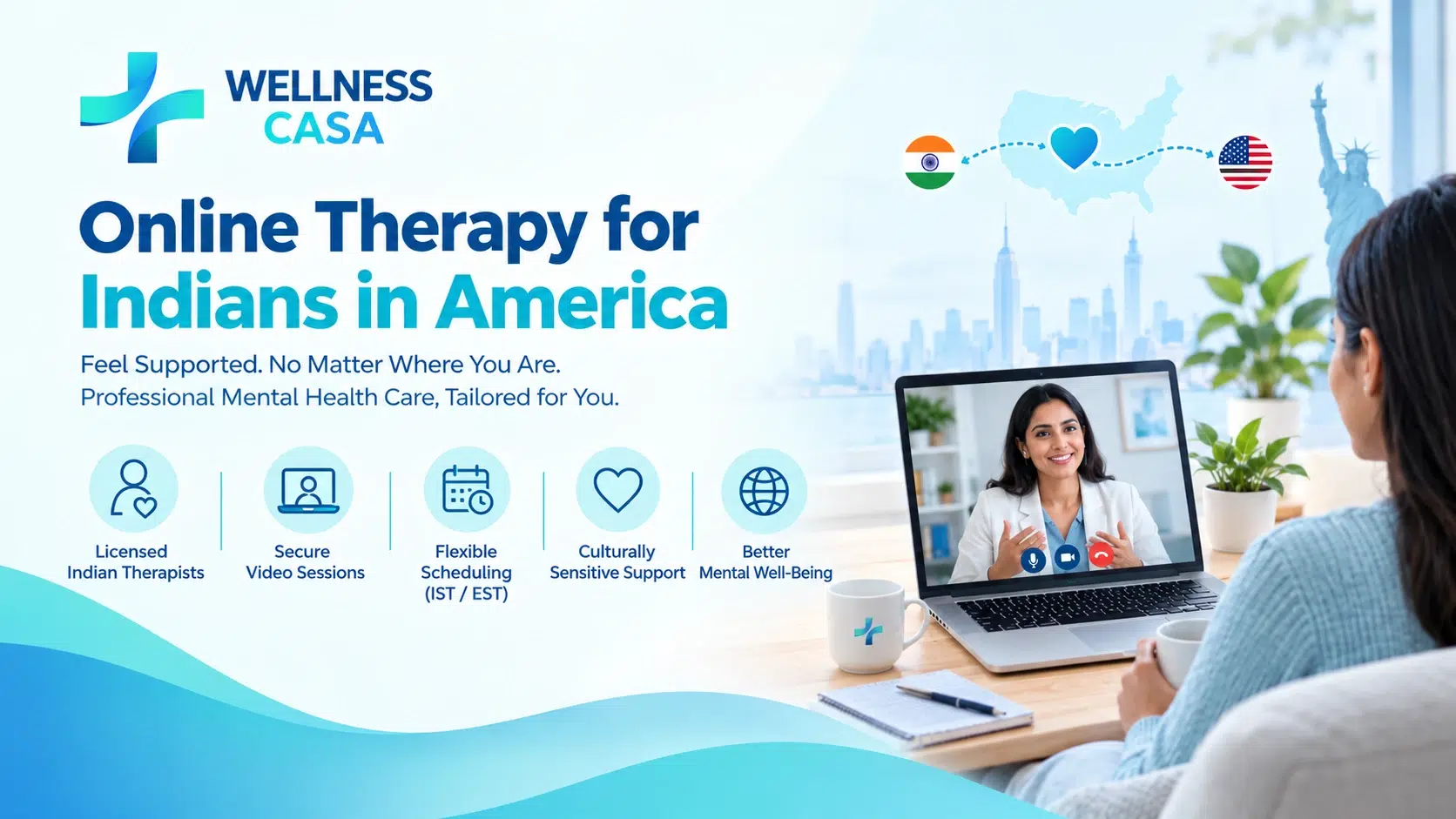
Online Therapy for Indians in America: A Complete Guide for First-Time Seekers
If you are an Indian living in America, there is a good chance you have said “I’m fine” far more often than you have meant it.
Maybe you moved here for a job, a degree, or a marriage. Maybe you grew up here, with one foot in your parents’ world and the other in your friends’. Either way, life gets heavy sometimes. Work pressure, visa uncertainty, loneliness, family expectations back home, and the quiet feeling that nobody around you really understands. And when you think about talking to someone, a hundred small voices appear. What will people say? Is this even a big enough problem? Where do I begin?
This guide is for exactly that moment. It is written for first-time seekers, so we will keep it simple and honest. We will cover what online therapy is, why it suits Indians in the USA so well, how to find the right therapist, what the first session feels like, and how to handle the doubts that stop most people from starting.
What Is Online Therapy, in Simple Words?
Online therapy means talking to a trained mental health professional through video call, phone call, or sometimes secure messaging, instead of visiting a clinic. You sit in your own room, on your own sofa, with your own cup of chai, and have a private conversation with a counselor or therapist.
The goal is the same as in-person therapy. You get a safe space to talk about what you are going through, understand your patterns, and learn practical ways to cope. The only difference is the setting. Online therapy is also commonly called teletherapy, telehealth counseling, or virtual counseling. If you see any of these terms, they point to the same idea.
Here is one important thing to say clearly. Therapy is a supportive process, not a magic fix, and no ethical provider can promise a guaranteed result. What it can offer is a structured, confidential space and tools that many people find helpful over time. Progress depends on your situation, your comfort with the process, and the effort you and your therapist put in together.
Why Online Therapy Works Well for Indians in the USA
Many Indians in America live busy, stretched lives. Online therapy fits into that reality better than most options.
Convenience is a big reason. If you work long hours in tech, healthcare, finance, or a small business, taking time off to drive to an office is hard. With online sessions, you save travel time and can often pick slots early in the morning or late in the evening.
Privacy matters more than people admit. In many Indian communities in the US, everyone seems to know everyone. A visit to a therapist’s office can feel risky if you worry about running into someone from your temple, your apartment complex, or your cousin’s friend circle. Sitting at home with headphones on gives you a level of discretion that feels safer.
Access is easier. Not every city has a therapist who understands Indian culture. If you live outside big metro areas, your local options may be limited. Online therapy removes the map from the equation and lets you look for someone who actually understands your background.
Time zones can work for you. Some people prefer sessions during hours that suit both their US schedule and their connection to family in India. A flexible schedule makes it easier to stay consistent, and consistency is where most of the benefit comes from.
If you want a deeper look at how counseling is set up for the Indian community abroad, you can read more about online counseling for Indians in the USA on our site.
Common Struggles Indians in America Bring to Therapy
People often assume therapy is only for “serious” problems. In reality, most people begin because of everyday pressures that slowly pile up. Some of the topics Indians in the USA often talk about include the following.
Homesickness and loneliness are probably the most common. You can have a full calendar and still feel alone. Missing festivals, family weddings, or a parent’s health scare from thousands of miles away leaves a particular kind of ache.
Then comes the stress of work and immigration. Visa timelines, job security, green card waiting periods, and the pressure to perform can keep your mind running all night.
Family expectations are another big one. Many of us carry the quiet duty to be successful, to send money home, to marry at the right time, or to be the “good child.” These expectations come from love, but they can also feel suffocating.
Relationship and marriage stress is common too, especially in new marriages where one partner has moved countries. Communication gaps, in-law dynamics, and adjusting to a new lifestyle can strain even strong relationships.
For second-generation Indian Americans, identity can be a real struggle. Feeling “too Indian” at school and “too American” at home is exhausting. Many young adults say they have never had a space where both parts of them were accepted.
Finally, there is plain burnout, anxiety, low mood, and the feeling of being stuck. You do not need a dramatic reason to talk to someone. Feeling “not like myself” for a few weeks is reason enough.
Why Cultural Understanding Matters in Therapy
Imagine trying to explain why you cannot say no to your mother’s weekly calls, or why skipping a family function feels like a betrayal, to someone who has never come across these ideas. You may spend half the session just explaining your culture instead of working on your problem.
A culturally aware therapist already understands joint family expectations, the weight of “log kya kahenge,” the pressure around education and career, and the way mental health is often brushed aside in many Indian households. You do not need to translate your life every time you speak.
Language can matter too. Some people feel more natural expressing emotions in Hindi, Tamil, Telugu, Punjabi, Gujarati, or another mother tongue. Where possible, ask whether a therapist can work in the language you think and feel in.
This does not mean a therapist from outside your culture cannot help you. Many can, and do. But if cultural context is important to you, it is perfectly fine to look for someone who gets it. Our guide on online counseling for NRIs in the USA goes further into this.
Understanding the Different Kinds of Support
Before booking, it helps to know who does what. The words get mixed up a lot.
A counselor usually helps with specific life challenges, such as stress, relationship issues, grief, or career confusion. A therapist or psychotherapist often works with deeper or longer-running patterns and emotional difficulties. A psychologist is trained in assessing and treating mental health conditions through talk-based methods. A psychiatrist is a medical doctor who can diagnose conditions and prescribe medicine.
Talk-based professionals do not prescribe medication. If you feel you need a medical evaluation, a licensed physician or psychiatrist is the right person to see. A good counselor will tell you honestly when something falls outside their scope and will point you in the right direction.
How to Find the Right Online Therapist
Choosing a therapist can feel like picking a doctor, a friend, and a guide all at once. Take it step by step.
Check their credentials first. In the United States, mental health professionals are licensed by individual states, and in most cases a therapist is expected to be licensed in the state where you are physically located during the session. Ask directly about their license, the state it covers, and their training. A trustworthy provider will answer without hesitation.
Look for relevant experience. Ask whether they have worked with Indian or South Asian clients, and whether they are familiar with concerns like immigration stress, cross-cultural families, or identity struggles.
Think about language and style. Do you want someone gentle and slow, or direct and practical? Do you prefer to speak in English, Hindi, or another language? There is no wrong answer, only what makes you feel at ease.
Read the privacy policy. Confidentiality is the foundation of therapy. A good provider will explain how your information is stored, who can access it, and what the limits of confidentiality are.
Be wary of big promises. If someone claims they will “cure” you in a fixed number of sessions or guarantees results, treat that as a red flag. Honest professionals speak about support and progress, not miracles.
Trust your comfort level. Many therapists offer a short introductory call. Use it. Pay attention to how you feel after the conversation. Did you feel heard, or judged?
What Happens in a First Online Therapy Session?
The first session is mostly about getting to know each other. There is no test, and you do not need to “perform” or arrive with a perfect story.
Your therapist will usually begin by explaining how sessions work, how confidentiality is handled, and what you can expect. Then they will ask what brought you here. You can start anywhere, even with “I’m not sure why I’m here.” That is a real and common starting point.
They may ask about your background, your daily routine, your sleep, your relationships, and what you hope to get out of therapy. You are free to share as much or as little as you want. Nobody can force you to open up before you are ready.
By the end, you and the therapist will usually discuss a rough plan, such as how often to meet and what to focus on first. Many people feel a little tired after the first session, and that is normal. Talking about feelings you have kept inside takes energy.
How to Prepare for Your Online Session
A few small things make a big difference. Find a quiet, private spot. If you share your home with family, flatmates, or a spouse, consider using headphones, choosing a time when others are out, or even sitting in your parked car if that is the only private space you have.
Test your internet connection, camera, and microphone ahead of time. Keep a glass of water nearby. Keep a notebook handy if you like to jot down thoughts. Give yourself a few minutes before and after the session. Rushing straight from a work meeting into therapy, then straight back to emails, leaves no room to breathe.
Most importantly, be honest about how you feel, even if it seems small or silly. Your therapist has heard many stories and will not judge yours.
What Does Online Therapy Cost, and Does Insurance Cover It?
Costs vary quite a lot, depending on the professional’s qualifications, location, session length, and the platform or practice. Some providers offer sliding-scale fees. Some take health insurance, while others work on a self-pay basis.
If you have health insurance, call your provider and ask whether mental health or telehealth sessions are covered, whether you need a referral, and what your co-pay or deductible looks like. Students at US universities should also check whether their campus offers free or low-cost counseling.
When you contact any therapist, ask about fees, cancellation policies, and session length upfront. A transparent practice will give you clear answers. If cost is a worry, tell them. Many practitioners would rather discuss options than lose someone who needs support.
Breaking the Stigma: The Doubts Many Indians Carry
Let us be honest about the elephant in the room. Many of us grew up hearing that talking about emotions is a sign of weakness, or that “problems stay inside the family.” Some of us heard “just pray,” “just adjust,” or “just focus on work.”
These messages come from generations who simply did not have the language or the resources we have today. They were not trying to hurt us. But carrying those beliefs into a new country, where you may have fewer people to lean on, can leave you quietly struggling.
Seeking help is not weakness. It is the same as seeing a doctor when your body hurts. You take care of your health, and your mind is part of your health. You also do not have to tell your family if you are not ready. Therapy is your personal space. When you feel ready, you can decide how much to share and with whom.
When Online Therapy May Not Be Enough
Online therapy works well for many everyday concerns, but it has limits, and it is important to be upfront about them.
Similarly, conditions that need medical evaluation, medication, or intensive in-person care require a licensed medical professional. A responsible therapist will tell you when this is the case and help you take the next step. Online counseling is a support, not a replacement for emergency or medical care.
Tips to Get the Most Out of Therapy
Therapy works best when you treat it as a partnership. Here are a few habits that help.
Be consistent. Skipping sessions whenever life gets busy makes it harder to build momentum. Decide on a regular slot, and protect it like you would any important appointment.
Say what is and is not working. If you feel the approach is not right for you, tell your therapist. Good professionals welcome this feedback.
Practice between sessions. If your therapist suggests small exercises, such as journaling, breathing practices, or setting boundaries, try them. Small steps add up.
Give it time. Many people expect to feel better in two or three sessions. For some it happens faster, for others it takes longer. Be patient with yourself.
Notice small wins. Maybe you slept a little better, or you finally said no to something without guilt. These count.
Final Thoughts
Starting therapy is rarely a dramatic moment. Most of the time, it is a quiet decision made on an ordinary evening, after a long day, when you realize you are tired of carrying everything alone.
If that sounds like you, know this: you are not behind, you are not overreacting, and you are certainly not the only one. Thousands of Indians in America are working through the same feelings of distance, pressure, and in-betweenness.
Online therapy gives you a private, flexible, and accessible way to begin. Take your time, ask questions, choose someone you feel comfortable with, and go at your own pace.
Frequently Asked Questions About Online Therapy for Indians in America
What is online therapy for Indians in America?
Online therapy means talking to a trained mental health professional through video or phone sessions from your own home. For Indians in America, it offers a private and flexible way to discuss stress, homesickness, family pressure, or relationship concerns with someone who understands their cultural background.
Is online therapy private and safe?
Reputable providers use secure, confidential platforms and explain their privacy practices before you begin. Confidentiality does have limits, such as situations involving serious risk of harm, and a good therapist will walk you through these in the first session.
Can I find a therapist who understands Indian culture and speaks my language?
Yes, many people look for therapists familiar with Indian family dynamics, immigration stress, and cross-cultural identity. Some also offer sessions in Hindi or other Indian languages. Ask about language and cultural experience when you first reach out.
How much does online therapy cost, and does insurance cover it?
Costs vary by provider, session length, and location. Some practices accept health insurance, while others are self-pay or offer sliding-scale fees. Check with your insurance company about telehealth mental health coverage, and ask any therapist about fees and cancellation policies upfront.
What happens in the first online therapy session?
The first session is a getting-to-know-you conversation. Your therapist explains how therapy works and how your information is kept confidential, then asks what brought you in. You can share at your own pace, and you do not need a diagnosis or a big reason to begin.
At Wellness Casaa, our aim is to offer a warm, respectful space where your culture, your language, and your story are understood and not explained away. If you are ready to take the first step, we are here whenever you are.
Disclaimer: This article is for general information and awareness only. It does not provide medical advice, diagnosis, or treatment, and it is not a substitute for professional care.