

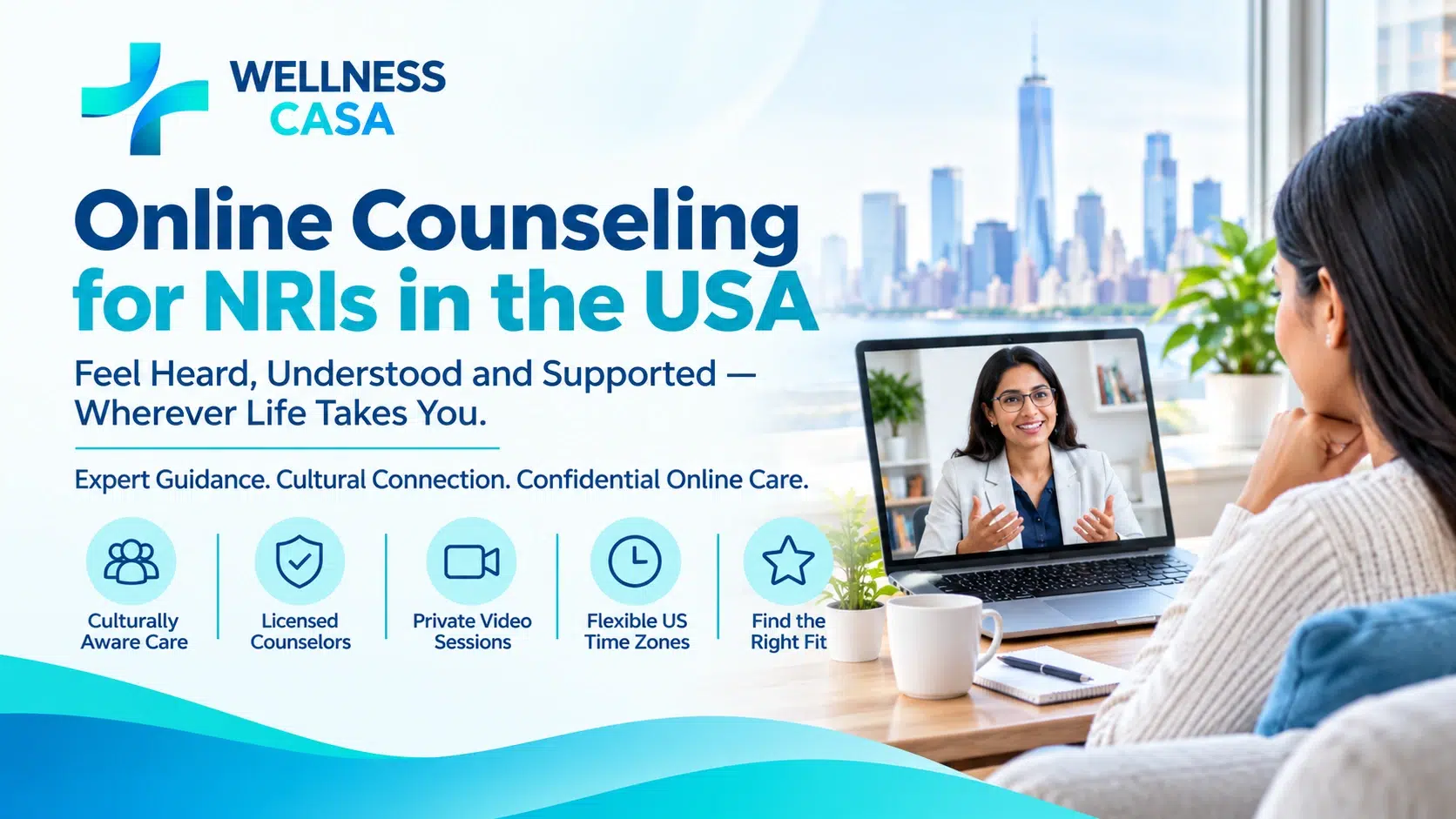
Moving to the United States is often described as a dream. Career growth, better exposure and the chance to build a new life are all real. But anyone who has lived through it knows the other side too. There is a quiet kitchen on a festival evening. There is the phone call home where you say “everything is fine” while your chest feels heavy. And there is the pressure of being the one who is supposed to have it all figured out.
If this sounds familiar, you are not alone, and you are not weak. Online counseling for NRIs in the USA has become a practical way for Indians abroad to talk to a trained professional without taking time off work, driving across town or worrying about being judged.
In simple words, online counseling is a private conversation with a qualified counselor over a secure video or audio call, where you can talk about stress, relationships, identity, loneliness or anything else that is weighing on you. This blog explains how it helps, who it suits, and how to choose the right counselor, so that your first step feels clear and not confusing.
What Is Online Counseling and How Does It Work for NRIs?
Online counseling, also called teletherapy or virtual counseling, is a form of talk-based support delivered through the internet. You book a session, join through a secure link at the agreed time, and speak with your counselor face to face on screen, just as you would in an office.
For NRIs, the format matters because it removes many practical barriers. You do not need to search for someone nearby who “gets it”. You can look for a counselor who understands Indian family structures, language and expectations, and sits in a very different place from you.
A typical session lasts around fifty minutes. Your counselor listens, asks gentle questions, helps you see patterns in your thoughts and feelings, and works with you on practical ways to cope. Counseling is not about being told what to do. It is about having a space where you can think clearly with someone trained to help you do that.
It is also worth saying what counseling is not. It is not a replacement for emergency care, and it is not a place where anyone promises a guaranteed outcome. Every person’s journey is different, and a good counselor will be honest about that from the start.
Why So Many NRIs Struggle in Silence
Before we get to the benefits, it helps to understand why the need is so strong in the first place. Many Indians abroad carry stress that is hard to explain to people who have not lived it.
Distance from family. Missing a parent’s illness, a cousin’s wedding or a grandparent’s last years can leave a deep, lasting guilt. Video calls help, but they do not fill the gap.
Identity crisis. You may feel too Indian for your American colleagues and too American for your relatives back home. Many NRIs describe a feeling of not fully belonging anywhere.
Work and visa pressure. Long hours, job insecurity and immigration timelines add a constant background worry that rarely switches off.
Parenting across two cultures. Raising children who grow up with American schools and Indian values brings its own questions, and sometimes its own conflicts at home.
The “What will people say?” effect. Even thousands of miles away, the fear of judgment from the community, relatives or the local Indian circle often stops people from speaking openly about mental health.
None of these are signs of failure. They are the natural emotional cost of building a life between two countries, and they deserve proper attention.
Key Benefits of Online Counseling for NRIs in the USA
1. A counselor who understands your cultural background
This is probably the biggest advantage. When you speak to someone who already understands why a Sunday call to your mother matters so much, or why saying no to family feels so heavy, you do not have to spend half the session explaining your background. You can go straight to the real issue.
Cultural understanding does not mean agreeing with everything. It means your counselor can hear what you are saying in the context it comes from, which makes the support far more meaningful.
2. Comfort of speaking in your own language
Emotions often come out most honestly in the language we grew up with. Many people find that they can describe a feeling in Hindi or their mother tongue in a way English simply cannot. Online counseling makes it possible to find a professional who can work in the language you are most at ease with. If you want to understand this better, our guide on online therapy for Indians in America explains what first-time seekers can expect.
3. Flexibility that fits a busy life
If you work in tech, healthcare, finance or run your own business, your calendar is probably packed. Online sessions remove commuting, waiting rooms and parking. Many people join from their home, their car during lunch or a quiet room in the office, at a time that works for them.
Time zones are another point. If you are in the US, you can find sessions that fit your early mornings or late evenings without hunting for a clinic that is open at those hours.
4. Privacy that feels safer
For many Indians, the biggest hurdle is not the cost or the time. It is the worry that someone from the community will see them walking into a therapist’s office. Online counseling gives you privacy. You decide where you sit, who is around and how much you share. For those worried about stigma, this can be the difference between getting help and putting it off for years.
5. Access, even when you live far from a city
The US is large, and many Indian families live in smaller towns where there may be very few mental health professionals, and even fewer who understand Indian culture. Online counseling gives you access to support regardless of your zip code.
6. Consistency during life transitions
Moving cities, changing jobs, getting married, becoming a parent, losing a family member back home or dealing with a visa change are all points where support matters most. With online counseling, you can continue sessions even when you move house, travel or change schedules, which gives you a steady anchor during unsettled times.
7. Support for the whole range of everyday concerns
People often assume counseling is only for serious crises. In practice, many NRIs come for things like ongoing stress, burnout, homesickness, relationship strain, difficulty setting boundaries with family, adjusting to a new country, low mood, sleep worries or the feeling of being stuck. You do not need to wait for things to become unbearable. Reaching out early is often easier than waiting.
Who Can Benefit from Online Counseling?
Online counseling can be useful for many different people, including students on F-1 visas who are far from home for the first time, young professionals adjusting to a demanding job, couples dealing with the pressure of a long-distance extended family, new parents who feel isolated, and older parents who have moved to the US to live with their children and feel disconnected from their old routines.
It is also useful for people who simply want to understand themselves better. You do not need a specific “problem” to benefit from having a space to reflect.
If you are interested in understanding the topic more broadly, you can also read our detailed piece on online counseling for NRIs in the USA.
Questions You Can Ask in Your First Conversation
Many first-time clients do not know what to say. Here are some simple questions that can help you feel more prepared.
- Have you worked with Indian or immigrant families before?
- How do you approach cultural differences, like family expectations or religion?
- What can I expect from the first few sessions?
- How will we know if the sessions are helping?
- What happens if I feel a session was not useful?
- How is my information kept private?
You do not have to ask all of these. Even two or three can tell you a lot about how a counselor listens and responds.
Warning Signs to Watch For
A good counselor creates a safe space. Be careful if someone promises a guaranteed cure, pressures you to continue without explaining why, dismisses your cultural background, shares your details without your permission, or discourages you from seeking other support. Ethical professionals are honest about what counseling can and cannot do, and they respect your right to decide.
What to Expect in Your First Online Session
If you have never tried counseling, the first session can feel nerve-wracking, so here is what usually happens.
Your counselor will start by explaining how the sessions work, including privacy and its limits. They will ask what brought you here and what you hope to get from the sessions. You may talk about your daily life, your family, your work and how you have been feeling lately. You do not have to share everything at once. Many people start slowly and open up as trust builds.
Before the session, find a quiet space where you will not be interrupted, check that your internet and camera work, and keep earphones nearby for privacy. Keep a glass of water and perhaps a notebook near you. These small details help you feel settled.
How to Get the Most Out of Online Counseling
Counseling works best when you treat it as a shared effort. Try to attend regularly, since steady sessions usually help more than occasional ones. Be honest about what is and is not working. Write down thoughts or questions between sessions so you do not forget them. Try the small steps you discuss in real life, even when they feel awkward. And be patient with yourself, because change generally happens gradually, not overnight.
It is also fine to say, “I do not know how to explain this.” A good counselor can help you find the words.
A Note on Privacy and Ethical Practice
Trust is the foundation of counseling. Reputable counselors and platforms follow professional ethics and the privacy rules that apply in the US. This generally means your sessions are confidential, with limited exceptions such as a serious risk of harm to yourself or others. Your counselor should explain these limits clearly at the start.
It is also worth being careful about where you find help. Choose services that are transparent about who their counselors are, what they offer and what they do not. Counseling is a form of support, and it should never be presented as a quick fix or a guaranteed outcome.
How Wellness Casaa Supports NRIs
At Wellness Casaa, our focus is on making mental health support feel familiar, respectful and accessible for Indians living in the USA. We understand that seeking help can feel like a big step, especially when family, culture and community expectations are involved. Our approach is built around listening carefully, respecting your background and helping you move at a pace that feels comfortable.
Whether you are dealing with stress, a major life change or simply the feeling of being far from home, you can explore our resources, including our guide on online therapy for Indians in America, to understand what support might look like for you.
Final Thoughts
Living far from home asks a lot of a person. You adapt, you adjust and you keep going, often without anyone noticing how much effort it takes. Online counseling gives you a space where you do not have to perform or explain everything. You can simply be heard.
Choosing the right counselor takes a little time, but it is worth it. Look for qualifications, cultural understanding, language comfort and an approach that feels respectful. Trust your instincts, ask questions and remember that you are allowed to change your mind.
If you have been thinking about reaching out, consider this your gentle nudge. You do not need a perfect reason, and you do not need to be at breaking point. Asking for support is not a sign of weakness. It is a way of taking care of yourself, wherever home happens to be.
You can also read more in our blog on online counseling for NRIs in the USA for further guidance.
Frequently Asked Questions
What is online counseling for NRIs?
Online counseling for NRIs is a private, confidential conversation with a trained counselor over a secure video or audio call. It helps people living abroad talk about stress, relationships, cultural adjustment and emotional wellbeing, often with someone who understands Indian culture.
Is online counseling as effective as in-person counseling?
Research on teletherapy has generally found that it can work well for many common concerns, especially for talk-based support. How well it works for you depends on your situation, your comfort with the format and how well you connect with your counselor.
How do I know if a counselor is qualified?
Ask about their license, training and the states where they can practice. A genuine professional will answer openly and clearly.
Can I get counseling in Hindi or another Indian language?
Yes, many people look specifically for counselors who can work in their first language. It is a good idea to mention your language preference when you first reach out.
Is online counseling private?
Reputable counselors follow professional ethics and applicable privacy rules. Your counselor should explain how your information is protected and the limited situations where confidentiality may not apply.
How many sessions will I need?
This varies. Some people find a few sessions enough to work through a specific concern, while others prefer longer support. Your counselor can discuss this with you based on your needs.
Is it okay to change my counselor?
Absolutely. Finding the right fit matters, and changing counselors is a normal part of the process.
Can I try online counseling if I am not in crisis?
Yes. You do not need to wait for a crisis. Many people use counseling to manage everyday stress, understand themselves better or handle a life transition.
Asking for support is not a sign of weakness. It is a way of taking care of yourself, wherever home happens to be.
Disclaimer: This article is for general information only and is not a substitute for professional medical or mental health advice, diagnosis or treatment.